Table of Contents
ToggleGeoinformatics can be broken down into two main components: the measurement of geoinformation and the management of geoinformation.
The measurement of geoinformation involves determining “what is where” (known as geometry) and “what is what” (known as identification). This typically involves using various tools and techniques to collect data about the Earth’s surface and features, such as satellite imagery, aerial photography, and ground-based surveys. The data collected is then analyzed and interpreted to determine the location and characteristics of different geographical features.
In more detail, the process of measuring geoinformation generally includes the following steps:
Once geoinformation has been measured, it must be managed effectively in order to make it useful for decision making and analysis. This involves several key tasks:
Overall, the field of geoinformatics encompasses both the measurement and management of geoinformation, with the goal of providing accurate, up-to-date, and actionable information about the Earth’s surface and features.
When it comes to measuring land, various tools and techniques have been employed throughout history, ranging from primitive methods to modern technology. Here’s a breakdown of some commonly used tools and techniques:
In ancient times, people relied on simple methods like pacing, using hands for estimation, and using rods for rough measurements. These methods were often based on intuition and human judgment. For instance, in the Vedic age, pacing was a common method where people walked a certain distance to measure land. The human figure was often used as a reference for estimation.
Pacing involves measuring distances by counting the number of steps taken. While this method is relatively simple and doesn’t require any equipment, its accuracy can vary depending on the individual’s stride length and consistency. Typically, the degree of accuracy is around 1 in 100, meaning there might be a slight margin of error. A common rule of thumb is that about 40 paces equal 100 feet.
As humans settled and began farming, more accurate methods of measuring land became necessary. Chains and compasses were among the earliest tools used for this purpose, followed by tapes and theodolites (an instrument for measuring horizontal and vertical angles). Electronic land surveying techniques, such as Total Stations and Global Positioning System (GPS) technology, offer greater precision and speed than traditional methods.
This technique involves capturing aerial photographs of the land and using them to create detailed maps and measurements. It provides a bird’s eye view of the terrain, allowing for comprehensive analysis.
Satellites orbiting the Earth capture imagery and data that can be used for land measurement purposes. This method offers a global perspective and is particularly useful for large-scale surveys.
GPS technology enables surveyors to pinpoint locations on the Earth’s surface with exceptional accuracy using signals from satellites. It has revolutionized land surveying by providing real-time positioning data.
Surveying is the practice of determining the relative positions of points on, above, or below the Earth’s surface by taking linear and angular measurements. It encompasses the art of establishing the spatial relationships between various locations, whether on a horizontal plane or in vertical dimensions.
Levelling, a subset of surveying, focuses specifically on determining the relative heights of different points on the Earth’s surface. This involves measuring elevations and gradients along vertical planes.
Surveying is a vital discipline in geomatics, which involves the measurement, analysis, and management of geographic information. At its core, surveying involves two main categories: surveying and laying out.
The first category, surveying, refers to the process of collecting data about the physical features of the land, such as its shape, slope, elevation, and location of structures. This is done using various surveying instruments and techniques, such as total stations, GPS, and levelling. The data collected is then processed and analyzed to create maps, diagrams, and other visual representations of the land.
This information serves as the foundation for planning and designing infrastructure projects, such as buildings, roads, bridges, and utilities. By having accurate and detailed information about the land, designers and engineers can create efficient and sustainable solutions that meet the needs of communities and businesses.
The second category, laying out, involves transferring the design specifications and plans created during the surveying phase onto the actual ground. This is done by physically marking out the location and alignment of various features, such as building corners, road edges, and utility lines, using surveying instruments and equipment.
By accurately laying out the designed features on the ground, contractors and builders can ensure that the constructed facilities conform to the approved design and meet the desired specifications and tolerances. This helps prevent costly mistakes, reduces waste, and improves overall quality and safety.
Effective communication and collaboration between surveyors, engineers, planners, and constructors are essential to ensure that the final product meets the needs and expectations of clients and stakeholders, while adhering to regulatory requirements and industry standards.
At its core, surveying involves collecting data about geographical points, creating accurate plans and maps, calculating areas and volumes, and translating these plans onto the physical terrain. It serves as an indispensable tool in civil engineering projects, providing crucial information for the planning and execution of infrastructure development.
Surveying serves multiple purposes, including:
1. Creating detailed maps of countries or regions, delineating cities, towns, villages, major roads, and territorial boundaries.
2. Generating topographical maps that illustrate natural features such as hills, valleys, rivers, and forests.
3. Compiling cadastral maps to define property boundaries, including fields, houses, and other real estate assets.
4. Producing precise plans and cross-sections for engineering projects like roads, railways, bridges, dams, and irrigation canals.
5. Developing military maps to strategize transportation networks and communication routes within a country.
6. Constructing contour maps to analyze reservoir capacity and determine optimal routes for roads and railways.
7. Creating geological maps to document underground resources and geological formations.
8. Mapping archaeological sites to preserve and study historical and cultural heritage.
Surveying, a crucial aspect of land measurement and mapping, is traditionally divided into two main branches: Plane Surveying and Geodetic Surveying.
Plane Surveying involves the measurement and mapping of relatively small areas where the curvature of the Earth’s surface can be neglected, and it is assumed to be flat. This method is suitable for regions spanning less than 250 square kilometers. In Plane Surveying, distances between points are treated as straight lines, and angles within triangles formed by these points are considered to be plane angles. Common applications of Plane Surveying include projects managed by state government departments such as irrigation and road construction.
Geodetic Surveying, on the other hand, accounts for the curvature of the Earth’s surface, making it ideal for large-scale projects where high precision is essential. This method is employed when conducting surveys over extensive areas exceeding 250 square kilometers. In Geodetic Surveying, lines connecting two points are viewed as curved due to the Earth’s spheroidal shape. Consequently, the angles within triangles formed by these points are considered spherical angles. The primary objective of Geodetic Surveying is to establish precise control points at significant distances from each other, serving as reference points for less precise surveys.
When it comes to measuring geoinformation, having a reference system is crucial. Think of it like this: when you make a map, you’re essentially bringing the ground into a laboratory setting and preserving its geometry on a flat surface. This means that any measurements taken on the map should correspond exactly to measurements taken on the actual ground.
But what kind of reference system should we use for geoinformation? When dealing with the entire Earth, finding a suitable reference can be challenging. After all, the Earth isn’t a smooth, flat surface – it’s an irregular, undulating sphere with varying densities of matter below the surface.
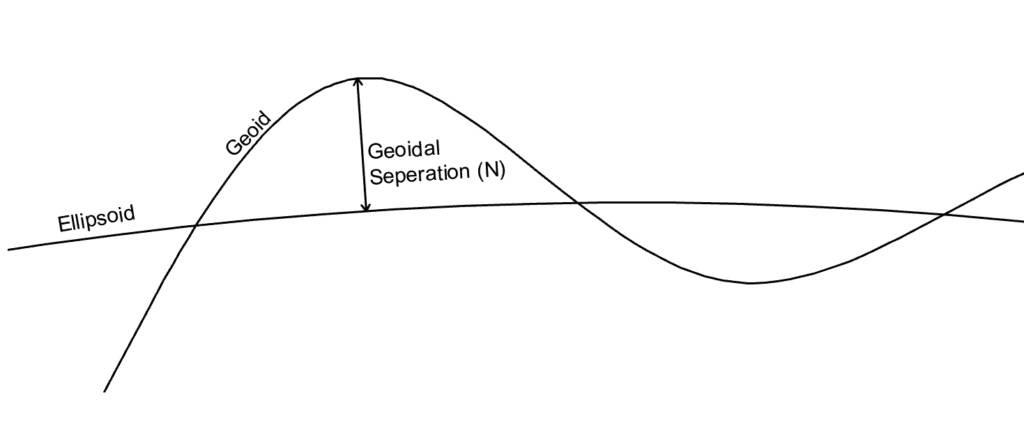
One option for a reference system is the geoid, which is an equipotential surface. Essentially, this means that the force of gravity is constant across the entire surface of the geoid. Interestingly, the geoid closely corresponds to the mean sea level, averaged over a period of 19 years to account for tidal variations.
However, while the geoid is a helpful tool, it’s not quite sufficient as a reference system for geoinformation. Because the density of matter below the Earth’s surface varies, the shape of the geoid itself is not perfectly regular or predictable. This makes it difficult to precisely locate points on the Earth’s surface using the geoid alone.
That’s where the ellipsoid comes in. The ellipsoid is a mathematically-defined surface that fits the Earth’s shape reasonably well, especially in smaller regions. By projecting points from the Earth’s surface onto the ellipsoid, we can get precise XY coordinates for those points. Additionally, we can measure the height of those points above the ellipsoid to get a complete set of coordinates.
Of course, there’s still one problem: the geoid and the ellipsoid don’t match up perfectly. In fact, there can be considerable variation between the two surfaces. To account for this discrepancy, we need to measure the geoidal separation (N) – that is, the distance between the geoid and the ellipsoid at any given point.

By combining the geoidal separation with the ellipsoidal height, we can get a full set of coordinates that reflect both the location and the elevation of any point on the Earth’s surface. This powerful combination of reference systems allows us to accurately measure and analyze geoinformation in a way that reflects the true complexity and variability of our planet.

Surveys play a crucial role in various fields, including engineering, architecture, geology, archaeology, and urban planning. They allow professionals to accurately measure and map out physical spaces, ensuring that projects are designed and executed correctly. Surveys can be classified in several ways, depending on the criteria used. Here are some common classifications of surveys:
Overall, surveys play a vital role in understanding the physical world and designing and executing projects that impact our daily lives. Advances in technology continue to improve the accuracy and efficiency of surveys, enabling us to tackle increasingly complex challenges.
The fundamental principles based on the various methods of plane surveying are
The main principle of surveying is working from whole to the part. To satisfy this rule, sufficient number of primary control points are established with higher precision in and around the area to be surveyed. For establishing these points more precise instruments are used. Minor control points are then established by less precise methods and the details can be located using these minor control points by running traverses. The main purpose of this principle is to control the accumulation of errors and to locate the error within the framework of control points. Other wise, if followed a reverse procedure i.e., working from part to whole, the errors would expand to greater magnitude and a stage will come these errors will become uncontrollable.
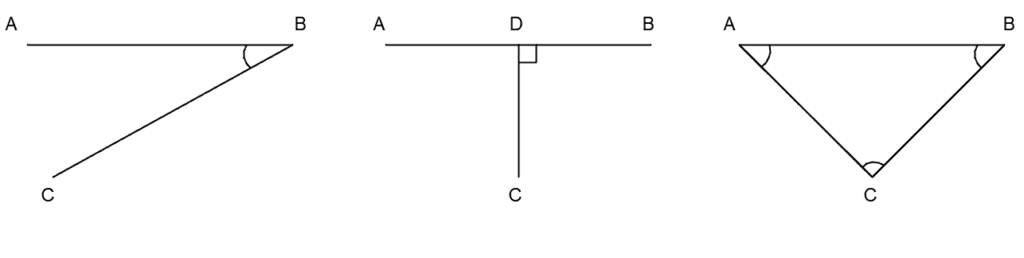
According to the second principle, the new stations should always be fixed by at least two measurements (Linear or Angular) from fixed reference points. Linear measurements refer to horizontal distance measured by chain or tape. Angular measurements refer to the magnetic bearing or horizontal angle taken by a prismatic compass or theodolite.
Lets A and B are two reference points. Any other point C can be located by one of the following methods.

Each method offers its unique advantages, catering to different scenarios and requirements. By understanding these techniques, accurately plotting points on plans becomes more manageable and precise.
Linear measurements involve distances along horizontal, vertical, or inclined planes. Traditionally, the Standard of Weights and Measurements Act (India) of 1956 designated meters (\(m\)) and centimeters (\(cm\)) as standard units. In modern practice, the International System of Units (SI) prevails, with measurements typically expressed in meters (\(m\)) and millimeters (\(mm\)). Before the adoption of SI units, linear measurements were often recorded in feet, with subdivisions such as tenths and hundredths of a foot.
\(Angular measurements are fundamental for determining direction and orientation. They are commonly expressed in degrees (\(^\circ\)) or radians (\(rad\)).
In this system, 1 circumference equals \(360^\circ\), with each degree further divided into \(60’\) (minutes) and each minute subdivided into \(60”\) (seconds).
\(Here, 1 circumference equals \(400\) grads, with each grad further divided into \(100\) centigrade (centi-grad) units.
\(Commonly used in navigation and astronomy, this system sets 1 circumference as \(24\) hours, with each hour divided into \(60’\) (minutes) and each minute further subdivided into \(60”\) (seconds).
\(Linear measurements are fundamental to various surveying techniques and involve determining distances along horizontal, vertical, or inclined planes. To achieve accurate and reliable measurements, surveyors utilize a range of specialized instruments and methods.
Survey operations involve several processes that help create accurate representations of the Earth’s surface. These processes can be broadly classified into three stages: field work, office work, and care and adjustments of instruments. we will explore each stage in detail and discuss their importance in the surveying process.
Field work is the first stage of survey operations, where surveyors collect data by taking linear and angular measurements in the field. This stage is crucial as it sets the foundation for the rest of the surveying process. The field work stage can be further divided into three sub-stages:
Once the field work is complete, the collected data is brought to the office for analysis and processing. The office work stage involves several activities, including:
The final stage of survey operations focuses on caring for and adjusting the instruments used in the field. Precision instruments, such as compasses, levels, theodolites, and EDM devices, require special care to ensure they function accurately. Here are some tips for handling these instruments:
Scales are an essential aspect of technical drawing and mapping. A scale refers to the ratio between the actual size of an object and its representation on a drawing or map. There are different types of scales, including:
There are also different types of scales used in technical drawing and mapping, including:
The length of a scale should be determined based on the maximum length of the object being represented, and should typically be between 10 and 15 cm. Plans and maps are typically drawn to a smaller scale than actual size, while detailed views of objects may be drawn to a larger scale. Topographic maps also include vertical distances, represented by contour lines, whereas plans do not.