
Survey Instruments Used For Chain Survey

1. Chain:

  •  For the measurement of the distance between two points the Chain is used.
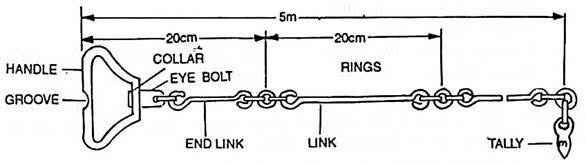
  • The total length of the chain is 20 meters, it comprises 100 links each 20 cm in length.
  • The brass handle at each and included in the length of the last link at either end.
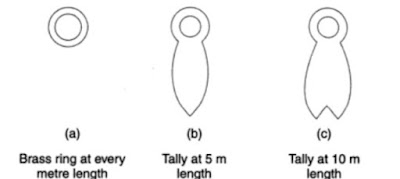
  • In the middle of the chain that is at 10 m from either end, there is a tally with two prongs, and at 5m from either end, there is a Tally with 1 prong.
  • The links are made up of galvanized steel.
  • The folding and unfolding of the chain are very convenient.
  • Before commencing to measure, therefore every measurer should test his chain with steel tape. The Chain should be laid out on the ground and measured with steel tape. If it is found incorrect the measurer must be careful to make the necessary allowances in the ensuring chain measurement and also to have the chain repaired correctly at the earliest opportunity.
  • The chain is driven by two chainmen called, respectively, the Backman(follower) and the Foreman(leader). The latter is provided with 10 iron spikes (called arrows) with which to mark off chains as they are measured.
  • In driving the chain,
    • The Backman places the handle at his end against the flagstone pit, etc., which marks the point of departure for the measurer standing behind him.
    • The point from which the measurement begins is called the starting point and the other end of the straight line to be measured is called the closing point.
    • The Foreman then stretches out the chain tight and flat upon the ground. measurer directing him to move right or left until the chain lies quite straight in the desired direction.
    • The Foreman then sticks an arrow into the ground at his end of the chain (or if the ground is very hard makes a cross thus X) and lays the arrows beside it.
    • The chain is then moved forward at the order of the measurer pulled by the Foreman, being swung a little on one side that the arrow may not be moved from its position. The process described above is then repeated.
    • As the chain is moved forward the Backman picks up the arrows one after the other until the measurement is complete. The total number of chains measured can then be found from the number of arrows in the hands of the Backman (those in the hands of the Foreman is also counted as a measure of check) and a number of links reckoned from the chain as it lies on the ground a half link or under being disregarded, and over half a link being taken as one full link (of course if the measurement completes a full chain then one more chain must be added to those reckoned by the arrows).
    • The arrows in the hands of the Foreman are then-returned to the Backman after the base. line-has have been measured. The offset line is measured in the same way the cross-staff is placed in the pit to mark the point to be measured.

2. Cross staff:

  • The cross-staff is an instrument used to measure altitude and angles consisting of trigonometry graduated staff
  • In using the Cross-Staff the first essentials are (I)accuracy. (II)quickness.

Upon the point of ‘accuracy’, there is no need to dwell. Inaccuracy in taking an angle can only be due to carelessness to guard against which no rules can be framed.
  • It is used for setting right angles
  • These are of three types
  1. Open cross-staff
  2. French cross-staff
  3. Adjustable cross-staff                                
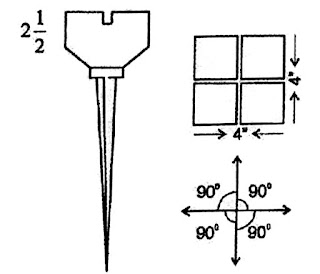
  • The dimensions of cross-staff are 10 x 10 x 6 cm (4″ x 4″ x 2.5″)
  • The cross-staff of is 1.5 m long and 16 mm in diameter
How to use the cross-staff: 

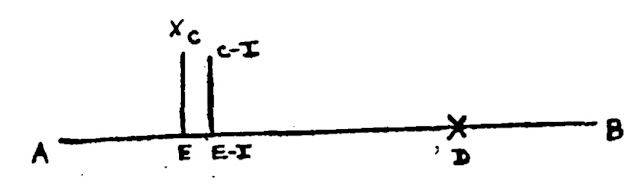
The needle at the end of the cross-staff should be placed firmly on the ground so that it is firmly fixed in the vertical position. If AB is the baseline and C is the point to which an offset is to be taken. then the object is to find the point E as quickly as possible. D is a third flag placed on the baseline close to the end towards which the measurer is proceeding to save him the trouble of constantly verifying relative positions of A and B. Point E is that place where the one groove of the cross-staff point directly down the base AB and the other groove at right angles directly to the point C. For this purpose, the Surveyor must move on to the baseline. To guide the cross-staff surveyor to remain on line AB, a third flag is always placed on the baseline close to the end towards which the measurer is proceeding. For walking on the baseline, it is always necessary for the surveyor to be guided by two flags in front of him.

The next step is to take the angle. The simplest way to get the approximate position is for the measurer to stand in the baseline and take the approximate angle across his chest to the offset flag. Having done this he can then drive in the cross-staff and the position will not be far wrong. If it is wrong then he should at once decide how far forwards or backward he should go to find the correct position.
It is a simple thing to decide whether the angle has been taken correctly or not. If it is found that the object is to the left or right from the approximate position he has selected he must at once move towards left or right as the case may be. For this purpose it is necessary to use the judgment as to how far is the object from the point he has sighted and to immediately move forward or backward approximately that much distance to arrive at the desired point.

To sum up. 
(a) keep the chain straight down the base fine, 

(b) before attempting to take the angle, fix upon a position approximately correct, 
(c) if it is wrong, decide quickly how far you are out.
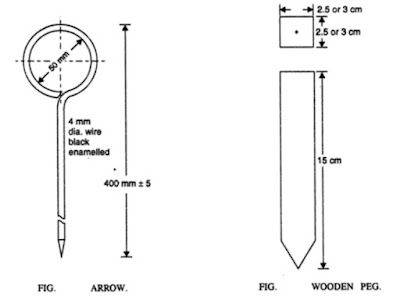
3. Arrows:

  • The arrows are used to mark the end of each Chain during the change process.
  • These are made up of hardened and tempered Steel 4 mm in diameter.
  • The length of Arrow is 400 mm and consists of a circular ring of diameter 50mm.
  • The arrows are placed on the ground after every chain length, the number of arrows held by the follower indicates the number of chains that have been measured. this provides a check over the length of the line as entered in the field book.

4. Standard pole:

 It is used to measure the length of the chain we use, whether it is accurate or not. This is because the chain expands in summer and shrinks in winter. This is 1.5″ in Diameter, 10 links long, made of bamboo or teak stick. Check the chain with this before making measurements.


About Technical surveyor

I'm B Mehaboob, a GIS and revenue land surveying professional with over 6 years of specialized experience in cadastral surveys, spatial data analysis, and project management. My expertise lies in leveraging cutting-edge technologies—including Total Station, GNSS systems, and QGIS—to deliver precise, reliable solutions for land acquisition, boundary surveys, and infrastructure development projects.

Leave a Comment